
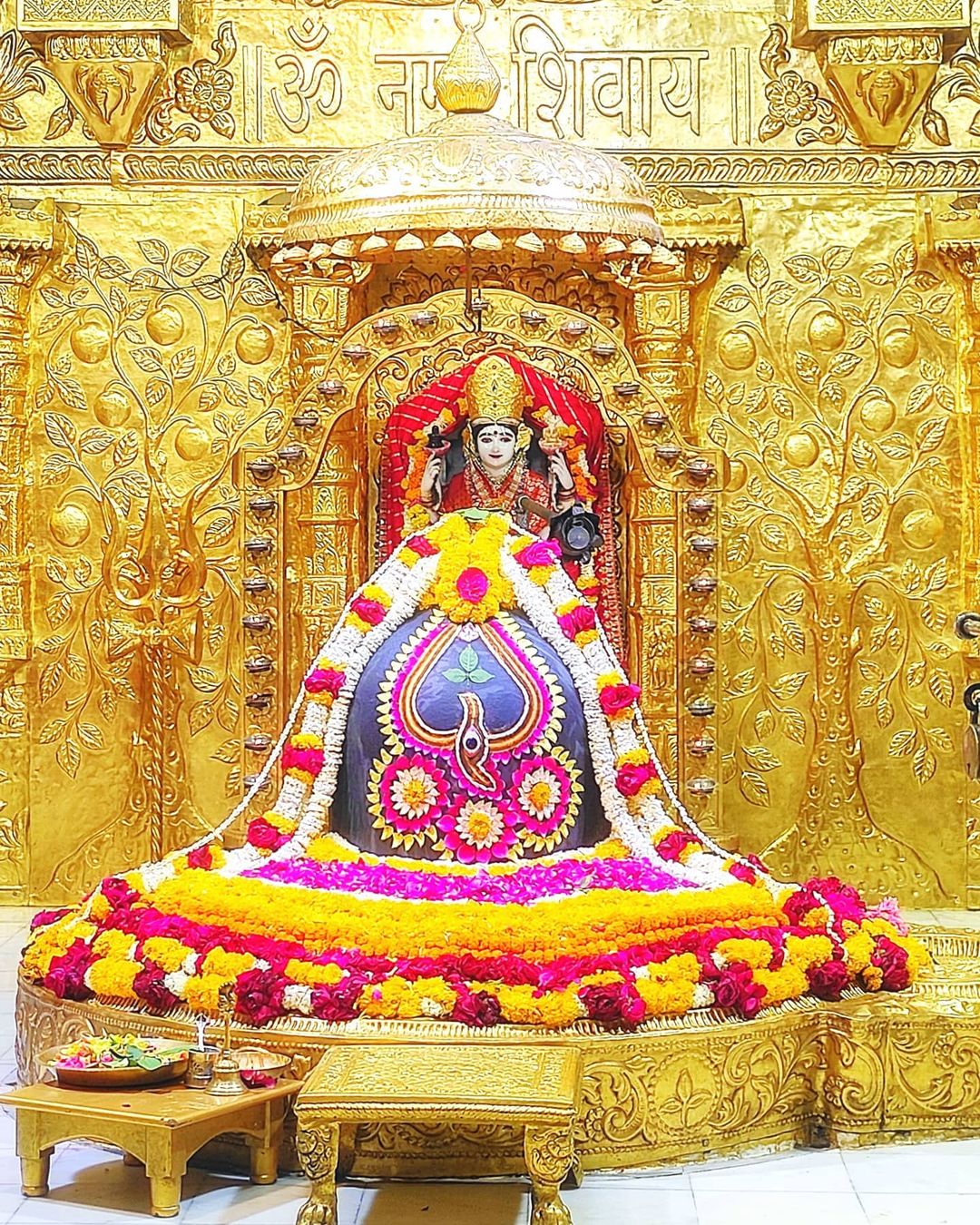
The Somnath temple is also known Somanātha temple or Deo Patan, is located in Prabhas Patan, in Gujrat, India. One of the most sacred pilgrimage sites for the Hindus, they believe it to be the first among the twelve Jyotirlinga shrines of Shiva.
The temples lies at the meeting of Kapila, Hiran and Sarasvati rivers and the waves of the Arabian Sea and flow touching the shore on which it is constructed. The ancient temple’s timeline can be traced from 649 BC but is believed to be older than that. The present form was reconstructed in 1951. Colourful dioramas of the Shiva story line the north side of the temple garden, though it’s hard to see them through the hazy glass. A one-hour sound-and-light show in Amitabh Bachchan’s baritone highlights the temple nightly at 7.45pm.
History :
The Somnath temple story starts with the partiality of Chandra (the Moon God) to Rohini, one of his 27 wives who were all daughters of Daksha Prajapati, the son of Brahma. The sisters of Rohini were jealous of the extra attention that Rohini received and complained of this to their father. In spite of a warning, the Moon did not mend his ways and the angered Daksha Prajapati cursed him, because of which the Moon lost his lustre.
Alarmed with the curse of Daksha Prajapati, the Moon rushed to Prajapati Brahma, the creator of the World. Brahma advised him to visit Prabhas Teerth, bathe in the Triveni Sangam where the rivers Hiran, Saraswati, and Kapila meet and worship Lord Shiva there. The Moon did as he was advised and was relieved of his curse. As a token of gratitude he built a temple in Gold to honor Lord Shiva and the temple came to be known as Somnath.
Interpretations from the Puranas say that the Moon had built a golden temple and entrusted the worship and upkeep of the temple to the Sompura Brahmins whom he had created specifically to do Yajnas and other ceremonial worship to Lord Shiva during the prathishta or installation ceremony of the temple.
Even today there lives in Somnath a community of Sompura Brahmins who trace their ancestry to the moon. In fact, when the Somnath Temple was rebuilt after Independence, the masons and artists who gave shape to it were from the Sompura Salat community, a branch of the Sompura Brahmin community known for their architectural and artistic skills.
Legend has it that ages after the Moon God built the temple of God, Ravana built a temple in silver, and later in the Dwapara Yuga Shree Krishna had a temple of wood built at Somnath.
As per the information on the website of the Somnath Trust, it is believed that the first Somnath Temple was built during the tenth Treta Yug of the Vaivswat Manvantar and calculate this to be some 7,99,25,105 years ago.
According to several archeological surveys, the Somnath Jyotirlinga initially used to levitate in mid-air. An intense science is there behind the mystically floating Jyotirlinga.
A 13th century Persian Geographer and traveler Zakariya al-Qazwini mentioned Somnath Temple in his book, “Wonders of Creation.” Mahmud Ghaznavi, a Turkish invader, attacked Bharat to covert and establish Islam in the region. He attacked Bharat many times and succeed to an extent. He attacked the prosperous cities and temples of Bharat. While fulfilling his evil purpose, he also attacked Somnath Temple in 1025.
Thousands of Hindus got killed who stood against the demolition of the Somnath temple. Mahmud Ghaznavi ordered his men to seize all the treasures worth millions during that time.
Mahmud Ghaznavi moved towards the Somnath Jyotirlinga floating in mid-air between the floor and the roof. Mahmud Ghanavi and his men were bewildered at sight. He enquired his attendants behind the reason for this levitating Shivlinga and what to do with it. Everyone gave their opinion and theories. Some said the Jyotirlinga hanged in mid-air with invisible support or rope. Ghaznavi ordered his men to investigate if there was any support that held the Jyotirlinga in mid-air. They failed to find any mechanism supporting the Jyotirlinga. One of his attendants came up with exceptional detail.
He explained to Mahmud Ghanavi that the creation of the Canopy of the Jyotirlinga took place using loadstone (magnetite), and the Jyotirlinga has a metal similar to iron. It explained the science behind the floating Jyotirlinga. Mahmud Ghaznavi threw his sword towards the Canopy after listening to the theory given by his attendant. Surprisingly, his sword got stuck to the Canopy. The Canopy was indeed a permanent magnet that held the Jyotirlinga in mid-air with its powerful magnetic force.
Our Ancient science was very much advanced during that time that even today, it surprise modern scientists. Apart from Somnath Temple, many ancient temples in India still spin the heads of modern researchers. It showcases the level of skills and techniques that our ancestors used to build these ancient marvels.
 Healthy Happiness