
The Indo-Pakistani War of 1971 was a military confrontation between India and Pakistan that occurred during the Bangladesh Liberation War in East Pakistan from 3 December 1971 to the fall of Dacca on 16 December 1971.
The first was a domestic conflict between Pakistan’s ethnic majority Bengalis, who dominated East Pakistan, and the ruling elite in West Pakistan. This conflict was apparent as early as 1952 when Bengalis began mobilising to force the State to recognise Bengali as a national language. On 21-22 February that year, the Pakistani armed forces murdered several students as well as numerous others in indiscriminate fire. This internal conflict precipitously expanded after the ruling junta of General Yahya Khan refused to convene Parliament following the 1970 elections in which the East Pakistan-based Awami League, led by Sheikh Mujibur Rahman, decisively defeated Zulfiqar Ali Bhutto’s Pakistan Peoples’ Party.
The consequences of these elections were monumental because the victors were tasked with writing Pakistan’s third constitution. Mujibur Rahman’s party, under the banner of the Six Point Agenda, had long advocated for greater federalism; separate convertible currencies; fiscal responsibility to be delegated to the federating units; as well as the right to maintain a separate militia. Each of these demands came in response to the west’s cultural, economic, and linguistic oppression; exclusion from the military and bureaucracy; as well as consistent and calibrated efforts to deprive Bengalis of their legitimate share of political power. The political elites in the West, spearheaded by General Yahya and Zulfiqar Ali Bhutto, wanted a strong federal government and found the Awami League’s Six-Point Agenda to be a thinly veiled demand for outright cessation.
Despite winning too few seats to veto any constitution offered by the Awami League, Zulfiqar Ali Bhutto refused to let his party participate in any convening of Parliament and made absurd demands for a power-sharing agreement. After Mujibur Rahman refused to cede and insisted upon the Awami League’s right to form the government, General Yahya Khan commenced Operation Searchlight, which was a brutal and thuggish military operation to disarm the Bengalis.
As refugees began fleeing into India, the second phase of the war began: a proxy war between India and Pakistan. With the monsoon looming, India had few military operations at hand. Given the riverine terrain of Bangladesh, any military operation had to wait until the monsoon was over. To ensure that China would not intervene on its client’s behalf, India would have to wait until winter when snow would preclude Chinese movements through the mountain passes. In addition to these meteorological and geographical constraints, India was ill-equipped to undertake military action in the spring of 1971. India used the summer to reposition forces from the west to the east and construct necessary infrastructure to support military operations while seeking diplomatic support from Russia and imploring the United States to counsel Pakistan to end what was clearly ethnic cleansing in East Pakistan.
US President Richard Nixon and his National Security Advisor, Henry Kissinger, were unmoved by India’s requests even though the United States did provide a significant amount of aid to subsidise in some measure the enormous and growing cost of caring for the refugees who continued to pour into India. Initially, while the refugees were both Hindu and Muslim, it increasingly became clear from West Pakistani forces’ violent actions that most of the refugees were Hindu Bengalis. At Independence, about one in four Pakistanis were non-Muslim minorities, most of whom were Bengali Hindus in East Pakistan.
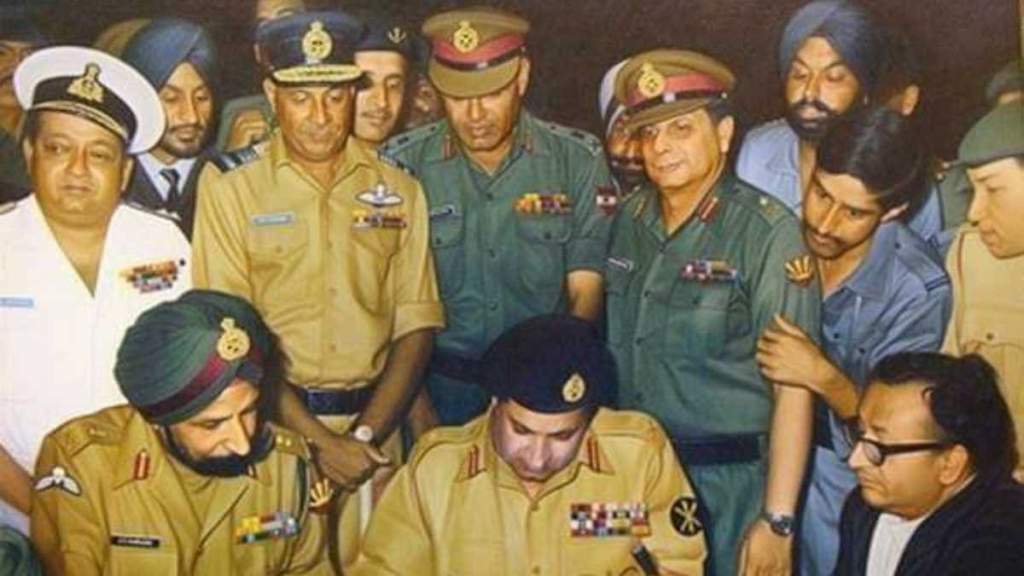
When the war ended on 16 December 1971, Pakistan was vivisected with East Pakistan emerging as an independent Bangladesh. Some 93,000 Pakistani soldiers surrendered to the Indian Armed Forces and were taken to India as POWs. Pakistan lost more than half of its population and about 15 percent of its territory. However, 61 percent of the 54,500 square miles (1,41,154 sq km) of land lost in the East was arable, in contrast to a meagre 21 percent of the 310,000 square miles (8,02,896 sq km) it retained. All said and done, the Pakistan Army was reviled for losing the East, which allowed Zulfiqar Ali Bhutto to ruthlessly rule the west until General Zia-ul-Haq ousted him in a coup in July 1977
 Healthy Happiness