
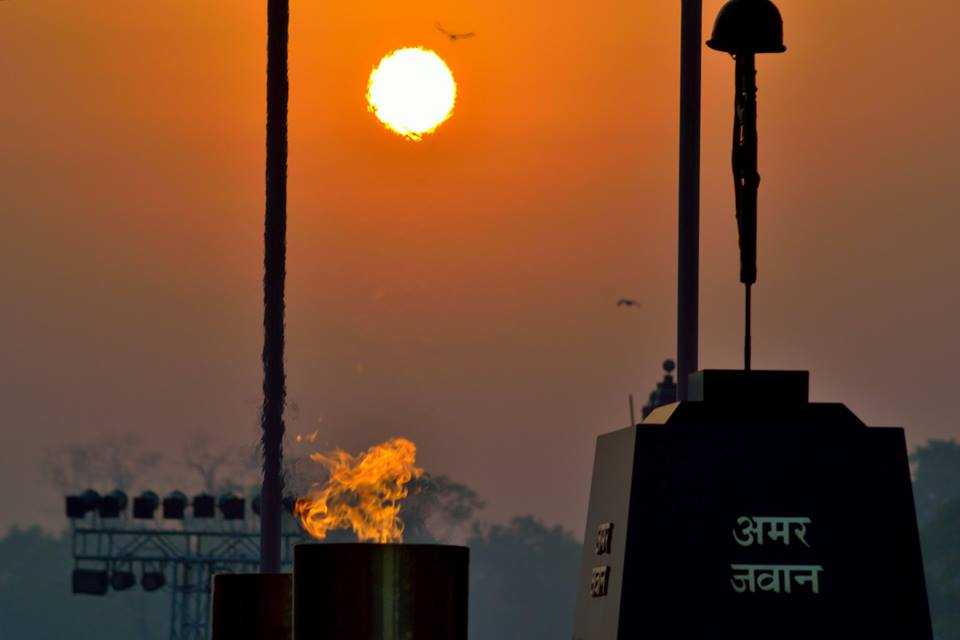
‘Amar Jawan Jyoti’ the eternal flame is one significant addition to India Gate in 1971, dedicated to the soldiers who lost their lives in the Indo-Pak war of December 1971. Amar Jawan Jyoti burns day and night under the arc of India gate as a tribute to the Indian martyrs. The burning flame rises from a platform that has a black colored marble cenotaph with a rifle and a soldier’s helmet placed on the barrel. The word ‘Amar Jawan’ is inscribed in gold on all the sides of the cenotaph. There are total four flames on each side of the cenotaph, which are lit up only on Independence Day and Republic Day. Liquefied petroleum gas was used to keep the eternal flame alive until 2006 after which it was lit up using piped natural gas.
Prime Minister Indira Gandhi fist paid homage to the Indian soldiers at India Gate on the eve of 23rd Republic Day on 26 January 1972. Since then, the Prime Minister of India pays tribute to the soldiers at this site along with the heads of Indian Armed Forces, before becoming the part of the annual parade held at Rajpath on each Republic Day.
The India Gate or ‘All India War Memorial’ is one of the most iconic national monuments of India and stands high in the national capital of Delhi. Situated on Rajpath, the monument was built in the memory of 90,000 soldiers who lost their lives during the First World War and the Third Anglo-Afghan War. 42 meters high, constructed with pale stone, red stone and granite; India Gate is inspired by ‘Arc De Triomphe’ in Paris and was designed by the British architect Sir Edwin Lutyens. The flags of Indian Army, Indian Navy, and Indian Air force are put behind the India Gate to represent the power of Indian Military.
 Healthy Happiness